
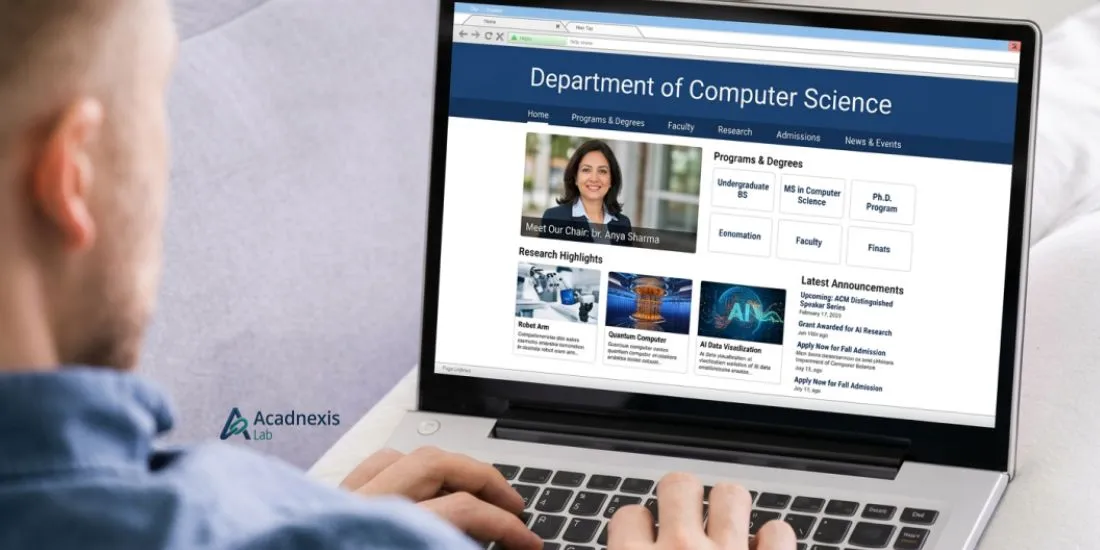
Designing an academic website that serves students, faculty, and researchers under one roof is one of the most complex – and most rewarding – challenges in digital strategy. An academic website is not a brochure. It is a living platform where prospective students evaluate programs, faculty establish scholarly credibility, and research teams attract collaborators and funding. This blog covers every critical layer of academic website design, from information architecture and faculty profile standards to research infrastructure – so your department site earns trust, ranks well, and genuinely serves the people who depend on it.
Key Takeaways
- A well-structured academic website serves three distinct audiences simultaneously: students, faculty, and research stakeholders
- Strong information architecture is the single most important design decision before any visual or technical work begins
- Faculty profile pages must function as professional scholarly portfolios, not static CV listings
- Research-intensive departments need dedicated scholarly journal infrastructure built into their site
- AI platforms like Google AI Overviews and Perplexity now pull answers directly from department pages – your content must be structured for both humans and machines
- A governance plan with named content owners is essential to keeping academic sites accurate long-term
Introduction
Academic publishing and academic recruitment both begin in the same place today – a search bar. Whether a prospective doctoral student is evaluating programs, a journal editor is vetting a faculty member’s publication history, or a funding body is assessing a lab’s research output, the department website is the first stop.
Yet most department websites fail their audiences. They bury application deadlines three clicks deep. They host faculty profiles that haven’t been updated since 2019. They display course listings that don’t reflect the current semester. These failures aren’t just inconvenient – they cost departments real applicants, real collaborations, and real research visibility.
The good news is that excellent academic website design follows a clear, learnable set of principles. This guide lays them out step by step – whether you’re building a department site from scratch, leading a university website redesign, or improving what already exists.
Table of Contents
- Why Academic Department Website Design Is a Strategic Priority
- Information Architecture: The Foundation of University Website Design
- Designing Faculty Pages That Build Scholarly Authority
- Essential Academic Website Features Every Department Needs
- Building Scholarly Journal Infrastructure Into Your Site
- Accessibility and Mobile Design Standards
- Content Governance: Keeping Your Site Accurate Long-Term
- Frequently Asked Questions
Why Academic Department Website Design Is a Strategic Priority
In 2026, the line between a department’s reputation and its digital presence has effectively disappeared. AI-powered search tools – from Google’s AI Overviews to Perplexity and ChatGPT browsing – pull answers directly from department pages to respond to queries like “best neuroscience PhD programs with computational focus” or “Professor X’s recent publications on climate modeling.”
If your academic website design isn’t structured to serve those queries clearly, your department simply doesn’t exist in those results.
Beyond discoverability, the stakes are concrete:
- Prospective students consult department websites before any other source when evaluating programs
- Faculty recruits assess department websites to gauge intellectual culture, lab resources, and colleague caliber
- Grant bodies and industry partners use research pages to evaluate collaboration worthiness
- Peer institutions form reputational impressions based on how professional and current a department site appears
A department website is not a cost center – it is one of the highest-leverage recruiting and reputation tools available to academic leadership.
Information Architecture: The Foundation of Website Design
Before a single color is chosen or a CMS is selected, the information architecture (IA) must be mapped. IA defines how content is organized, labeled, and navigated. The primary reason visitors leave academic websites without finding what they need.
For university website design at the department level, includes these core pages:
i) Homepage includes department mission, featured research, latest news, and navigation pathways for each audience such as students, faculty, and visitors
ii) Programs & Degrees – Separate, detailed pages for undergraduate, graduate, doctoral, and certificate programs, each with curriculum requirements, learning outcomes, and application information
iii) Faculty Directory – A searchable, filterable listing linking to individual profile pages, organized by research area or alphabetically.
iv) Academic Journals and Publications – a specific area for institutions to show its associated journals, departmental publications, working papers, and scholarly periodicals. This helps to showcase who are included in research, collaborators, and those seeking citations with one organized place to look through, access, and refer to the published intellectual output of the department.
v) Research – Labs, centers, active projects, current grants, and funding acknowledgments
vi) Courses – Current and upcoming semester listings with direct links to syllabi where available
vii) Admissions – Requirements, deadlines, financial support options, and contact information for the graduate or undergraduate coordinator
viii) News & Events – Department seminars, visiting lectures, award announcements, and alumni news
ix) Contact & Location – Department office address, administrative staff directory, map, and social media links
Every page in this structure should answer one clear, specific question in the visitor’s mind. When users have to guess where information lives, they leave.
Designing Faculty Pages That Build Scholarly Authority
A faculty profile page is the most personal and most consequential page on any faculty website design. It is simultaneously a professional credential, a search-ranked document, and a first impression for every student, collaborator, or journalist who looks up that faculty member’s name.
What every faculty profile must include:
- A professional, recent headshot – not a stock image, not a casual photo
- A concise biography of 150–250 words written for a general intelligent audience, not only specialists in the field
- Research interests described in plain language with naturally embedded keywords
- A complete publications list with DOI links, open-access preprint links, or repository links wherever available
- Current and recent courses taught, with links to syllabi when permitted
- Lab or research group affiliation with a link to the lab page
- Direct contact email and current office hours
- Links to verified external profiles: Google Scholar, ORCID iD, ResearchGate, and LinkedIn
The most common mistake departments make with faculty pages is allowing completely unstructured self-management, which results in wildly inconsistent formatting, outdated information, and pages that look amateurish compared to competing institutions. Use a structured template within your CMS that enforces consistency while still giving faculty flexibility in the content they contribute.
Essential Academic Website Features Every Department Needs
The most effective academic website features are not visually dramatic – they are functionally reliable. These are the capabilities that determine whether a visitor accomplishes their goal or abandons the site in frustration.
i) Site-Wide Search – An effective internal search is a must. Students must be able to type “spring application deadline” or “computational biology electives” and receive accurate results – not a link to a generic Google search.
ii) Mobile-First Responsive Design – Nearly half of all academic web traffic originates from mobile devices. Every layout decision must be validated on a 375px smartphone screen before being approved on desktop. Test on both Safari (iOS) and Chrome (Android) as a minimum.
iii) Integrated or Synced Course Catalog – Manually updated course listings go stale within weeks. Where possible, integrate the department site with the institution’s Student Information System so schedules and course details update automatically each semester.
iv) Research Publication Repository – A dedicated research section organized by year, faculty member, and research theme, with open-access links wherever possible. This dramatically improves both discoverability and citation rates.
v) Event Calendar with Filtering – A filterable calendar of seminars, colloquia, visiting speakers, and workshops keeps the department site feeling active and signals intellectual vitality to all audiences.
vi) Clear Calls-to-Action (CTAs) – Every major page should direct visitors toward a specific next step: Apply Now, Request Information, Contact Admissions, or View Lab Page. Visitors should never have to wonder what to do next.
Building Scholarly Journal Infrastructure Into Your Site
For research-intensive departments, the website must do more than serve students – it needs to function as a scholarly journal infrastructure hub that supports the full academic publishing ecosystem.
1) Research Lab Pages should each include the lab’s active and recent projects, current funding sources and acknowledgments, team member profiles, open positions for graduate students and postdoctoral researchers, and recent publications or preprints.
2) Working Papers and Preprints deserve dedicated space on the department site, allowing faculty to share research in progress with the broader academic community ahead of formal peer review. Link these submissions to discipline-appropriate repositories: arXiv for STEM fields, SSRN for social sciences and law, bioRxiv for life sciences.
3) Data and Code Sharing is now expected by most major journals and funding bodies including NSF, NIH, and Horizon Europe. Department sites should host or prominently link to datasets, GitHub repositories, and supplementary research materials – demonstrating transparency and substantially increasing citation rates.
4) Seminar and Colloquium Archives – A well-maintained archive of past visiting lectures, department seminars, and conference presentations demonstrates that the department is an active, engaged intellectual community. This matters to prospective graduate students and potential faculty recruits more than most administrators realize.
Accessibility and Mobile Design Standards
The RPwD Act 2016 is India’s primary disability rights legislation, and GIGW (now aligned with WCAG 2.0/2.1 standards) is the government-mandated accessibility framework that Indian educational institutions — particularly those receiving public funding — are expected to follow.
Compliance requires:
- Color contrast ratios of at least 4.5:1 for standard body text
- Proper semantic heading structure throughout every page
- Descriptive alt text on every image, including faculty headshots and research figures
- Full keyboard navigability without requiring a mouse
- Captions on all embedded video content
- Forms that work correctly with screen readers such as NVDA and VoiceOver
Beyond legal compliance, accessible sites rank better in search – Google’s crawlers effectively function as screen readers, and sites that are easy for assistive technology to parse are rewarded in rankings.
Content Governance: Keeping Your Site Accurate Long-Term
The most common reason academic department websites degrade after launch is the absence of a governance plan. Content ownership must be assigned explicitly:
- Departmental administrative staff – course listings, event calendar updates, news posts, office contact information
- Individual faculty members – their own profile pages and lab site content
- Graduate coordinator – admissions requirements, deadlines, funding information
- Department chair or communications lead – homepage content, major strategic announcements, department mission statement
Schedule quarterly content audits to retire outdated pages, refresh faculty profiles, verify all external links remain active, and confirm that admissions information reflects the current academic cycle. A broken link or a profile for a faculty member who left two years ago signals institutional neglect to every visitor who encounters it.
Set automated reminders within your CMS to flag any page not updated within 12 months for mandatory review before it can remain published.
Frequently Asked Questions
Clear, audience-focused navigation that helps students find programs, faculty showcase their work, and researchers share their output - all without friction. Everything else, including visuals and technical features, supports that core goal.
Course listings and events should be updated each semester. Faculty profiles should be reviewed at minimum annually. Admissions deadlines must be verified before each application cycle opens. Homepage content should reflect the current academic year at all times.
Yes. Individual faculty profile pages are important for professional credibility. A single directory that includes thumbnail photos and one-line bios does not provide enough information for a department that is active in research.
University level websites are used for institutional branding, enrollment management and cross-campus navigation. Department websites delve into details of programs, research specialties, individual faculty, and scholarship. Department websites are tailored to a more niche group and have more specific needs as well, but they also need to meet the branding and navigation standards of both.
Final Thoughts
A great academic department website is not a one-time project – it is a continuously maintained digital ecosystem that reflects the intellectual vitality of the people and research it represents. When designed with intention, it becomes a recruitment engine for students, a professional showcase for faculty, and a research discovery platform for the wider academic community.